Work Management and Control of Work are often treated as separate disciplines. In practice, they are closely interconnected. The effectiveness of Control of Work depends heavily on the quality, stability, and
predictability of Work Management.
Organisations frequently focus on permits, isolations, authorisations, and procedural compliance while overlooking one of the most significant contributors to operational risk: unstable execution.
Control of Work Begins Before the Permit
Strong Control of Work does not start in the permit office. It starts much earlier, with how work is planned, prioritised, prepared, scheduled and executed.
When work execution is stable and well-coordinated:
- Work scopes are clearly understood
- Activities are properly prepared in advance
- Sequencing becomes clearer
- Simultaneous operations areeasier to identify and manage
- Permit quality improves through better pre-execution review
- Isolation planning becomes more robust
- The operational environment becomes more predictable
This predictability is critical because Control of Work systems are designed to manage risk within a structured environment. As operational instability increases, those controls become harder to sustain.
How Reactive Work Increases Risk
In highly reactive organisations:
- Plans change at the last minute
- New work is inserted withoutproper preparation
- Priorities shift continuously
- Teams rush to recover lost time
- Coordination between departments deteriorates
- Hand offs become less effective
- Permits, isolations, andsimultaneous activities exceed manageable levels
Under these conditions, the likelihood of error rises significantly.
This is rarely due to a lack of commitment to safety. More often, the system itself has become unstable. Human performance degrades in environments characterised by constant change. Operational risk increases not only because of the work itself, but because of the conditions under which the
work is executed.
Work Management Is a Risk Control Function
Work Management should never be viewed purely as anefficiency or productivity topic. It is fundamentally a risk control discipline. Effective Work Management:
- Reduces variability
- Improves coordination
- Protects focus
- Enables proper preparation beforeexecution begins
- Helps identify conflicts andmanage interfaces early
- Controls simultaneous operations before they create exposure
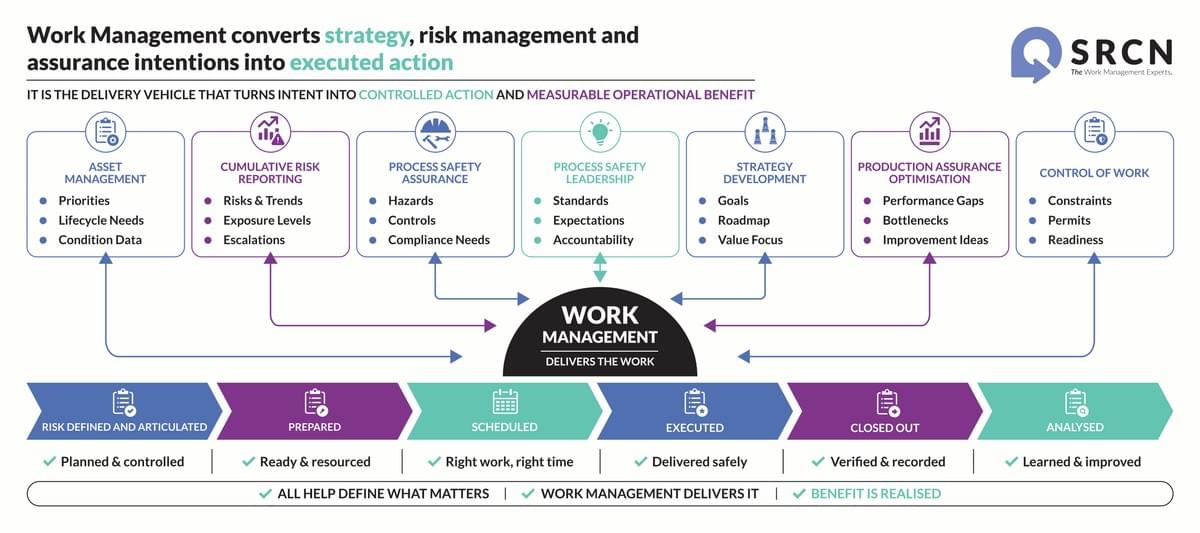
In contrast, poor Work Management undermines Control of Work long before permits are issued.
No permit system, regardless of its complexity, can fully compensate for unstable execution environments. If schedules constantly change, work enters the system unprepared, or execution capacity is routinely
overloaded, Control of Work processes become increasingly difficult to maintain.
Stabilising the Work System
Organisations often respond to Control of Work challenges by adding more procedures, approvals, meetings, and administrative checks. While governance is important, these measures rarely address the underlying source of instability. A more sustainable approach is to stabilise the work itself by:
- Reducing unnecessary break-ins and schedule disruption
- Improving work preparation standards
- Clearly defining work scopes before execution
- Aligning priorities with execution capacity
- Protecting schedules from excessive reactive work
- Creating operational rhythms that support coordinated execution
The Result: Safer and More Resilient Operations
When Work Management improves, Control of Work becomes easier to execute effectively.
- Permit quality improves
- Isolation risks are reduced
- Simultaneous operations become more manageable
- Supervisors and operators gain greater clarity and decision-making capacity
The outcome is not simply improved efficiency.
It is a safer, more controlled, and more resilient operating environment.
High-performing organisations understand that effective Control of Work is not achieved solely through stronger permits or additional procedural layers. It is achieved by creating stable operational conditions,
where disciplined execution can occur predictably and safely.
Ultimately, the effectiveness of Control of Work depends on the stability of the work being controlled.
#SRCN/ARTICLES
